
A Scaleup Accelerator
Zero Drift Execution
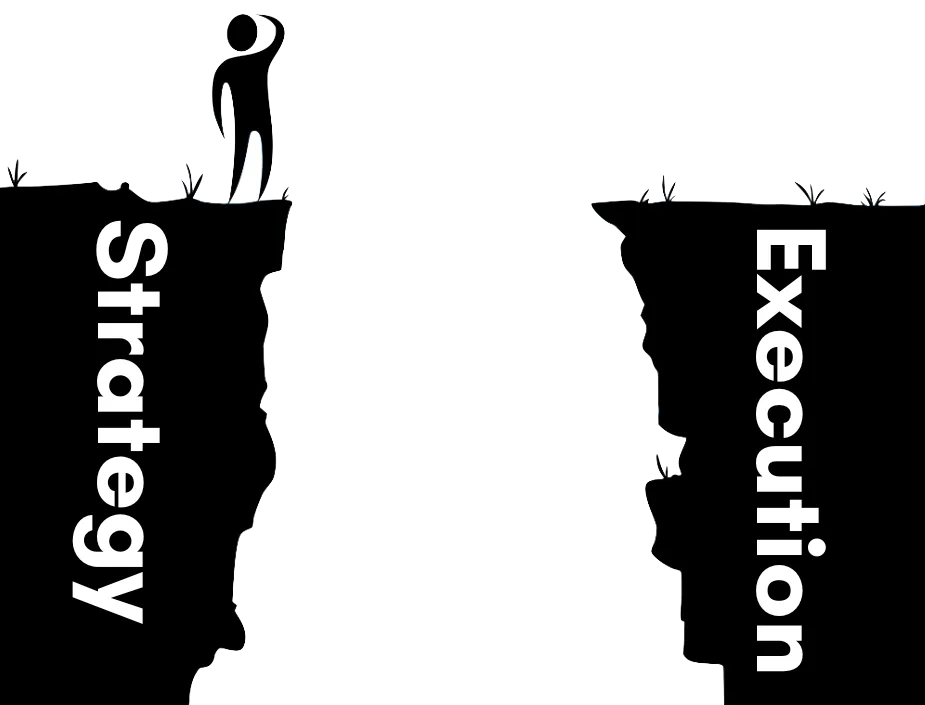
As organizations grow, execution drifts from strategy. Many organizations respond by improving execution alone. Servlinx proposes a different approach: Coherence before Control.
Organizations don't act directly from intent or directly upon current reality. They act from representations of both.
Their people and AI systems act toward a goal (a representation of intent) upon a state (a representation of current reality).
Servlinx continuously corrects both goal drift from intent and state drift from current reality to achieve Zero Drift Execution.
Strategy

Execution
Trusted by some of the fastest growing private companies in Inc 500


Gap Between Strategy and Execution
Why does execution become harder as companies grow,
even when the strategy is clear,
the team is capable,
and the tools keep getting better?
Every founder experiences it.
In the beginning,
everyone understands what needs to happen.
Conversations are short.
Decisions are fast.
Execution feels effortless.
Then the company grows.
New people join.
Customers evolve.
The product changes.
Teams specialize.
Knowledge spreads across conversations,
documents, meetings, and operational systems.
The company is still moving,
but no longer as one.
Different teams begin acting on different understandings.
Priorities become diluted.
Context gets lost.
What the company is acting toward can gradually separate from what the founders intended.
And what the company believes to be true can gradually separate from current reality.
Most organizations respond by trying to improve execution.
More meetings.
More dashboards.
More processes.
More automation.
But execution is not necessarily where the drift begins.
Execution is where the drift becomes visible.

Goal Is the Representation of Intent Made Actionable
Every organization begins with intent.
A founder sees a future that doesn't exist yet.
That future gives direction to everything that follows.
But an organization cannot act on intent alone.
Intent must first be represented in a form that people can act on.
We call that representation a goal.
A goal may be embodied through strategy,
priorities, objectives, OKRs, targets, initiatives, or other forms that make intent actionable.
As companies grow, those representations spread across more people, teams, and layers.
Each translation creates an opportunity for drift.
Strategy can shift.
Priorities can change.
Objectives can become disconnected.
Metrics can become ends in themselves.
Teams can execute their local goals exceptionally well while gradually moving away from what the organization originally intended.
This is goal drift from intent.
The problem is not that goals change.
Goals should change as the company learns and current reality changes.
The problem begins when those changes no longer remain coherent with intent.
Before acting on a goal, make sure it still represents the intent.

State Is the Representation of Current Reality Made Actionable
Current reality tells an organization where it is.
But an organization cannot act on current reality directly.
Current reality must first be represented in a form that people and systems can act on.
We call that representation state.
State may be embodied through data, conversations, reports, dashboards, operational systems, knowledge bases, AI systems, or other forms that make current reality actionable.
But current reality never stands still.
Customers change.
Products evolve.
Teams grow.
Markets shift.
Every change creates an opportunity for drift.
Data can become outdated.
Reports can become incomplete.
Dashboards can preserve yesterday's assumptions.
Operational systems can contain only part of what is actually happening.
Teams can act exceptionally well on the state available to them while gradually separating from what is true now.
This is state drift from current reality.
The problem is not that state changes.
State should change as current reality changes.
The problem begins when those changes no longer remain coherent with current reality.
Before acting on a state, make sure it still represents current reality.
How Servlinx Delivers Zero Drift Execution
Companies act on a goal (representation of intent) and a state (representation of current reality), whether they think about it that way or not.
As companies grow, goals and states spread across more people, teams, processes, and systems. Over time, goals can drift from intent and states can drift from current reality.
Execution then acts on those drifted representations, causing results to increasingly differ from what the organization intended.
Servlinx continuously keeps goals coherent with intent and states coherent with current reality before and while the organization acts.
Together, the System of Intent, System of Current Reality, and System of Execution form the foundation of Zero Drift Execution.

System of Intent
Continuously keep goals coherent with intent.
Every organization begins with intent.
That intent is made actionable through goals, including strategy, priorities, objectives, OKRs, targets, initiatives, and other forms.
As organizations grow, these representations spread across more people, teams, processes, and systems.
They also change as the organization learns and adapts.
Change itself is not drift.
Drift begins when those changes no longer remain coherent with the intent they were meant to serve.
Teams can execute their goals exceptionally well while the organization gradually moves away from what it originally intended.
Great execution doesn't guarantee the right destination.
The System of Intent continuously detects and corrects goal drift from intent, helping the organization adapt its goals without losing coherence with what it is trying to create.

System of Current Reality
Continuously keep state coherent with current reality.
Every organization operates within a current reality.
That reality is made actionable through state, including data, conversations, reports, dashboards, operational systems, knowledge bases, AI systems, and other forms.
As organizations grow, these representations spread across more people, teams, processes, and systems.
Current reality also changes continuously.
Change itself is not drift.
Drift begins when state no longer remains coherent with the current reality it is meant to represent.
Teams can execute exceptionally well while acting on a state that is incomplete, outdated, or no longer true.
Great execution doesn't guarantee the right outcome.
The System of Current Reality continuously detects and corrects state drift from current reality, helping the organization update its state as reality changes so decisions remain grounded in what is true now.

System of Execution
Continuously translate goal and state into coherent action.
Every organization depends on execution.
Execution acts on the organization's representations of intent and current reality.
Goals tell the organization what it is trying to achieve.
State tells the organization what is true now.
Together, they provide the direction and context from which execution acts.
As organizations grow, execution becomes increasingly distributed across people, teams, processes, software, and AI systems.
Great execution isn't just about doing things well.
It's about acting from goals that remain coherent with intent and state that remains coherent with current reality.
The System of Execution continuously translates coherent goals and state into action, producing results that become part of a new current reality—and allowing the cycle to continue.

Book your Call
This isn't a sales call.
It's a Zero Drift Execution assessment.
As companies scale, the representations from which they act become increasingly distributed across people, teams, processes, and systems.
Goals can drift from intent.
State can drift from current reality.
And execution can act on both without the drift being immediately visible.
Together, we'll identify where drift is occurring, and what it would take to restore coherence.
Together, we'll explore:
* how well your goals represent your organization's intent,
* how well your state represents your organization's current reality,
* whether execution itself is contributing to the gap,
* and what it would take to restore Zero Drift Execution.
If Servlinx can help, we'll show you how.
If not, you'll still leave with a clearer understanding of where your organization stands today.

Contact
© Copyright 2026 Servlinx. All rights reserved